
The method
Why six minutes actually works
Most revision plans fail for one reason: they need more time and willpower than a real evening has. SATs in 6 was built around a stricter question — not "what's the ideal amount of revision?" but "what will we actually do, every day, without a fight?"
The three steps
-
1
Pick a subject
Start with the area that needs the most attention — General Maths, General English, or Arithmetic — or run all three together as the full bundle.
-
2
Six minutes a day
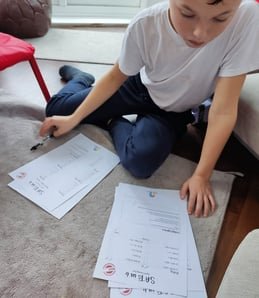
Monday to Friday, one short paper. Space for workings, a tick-or-cross box for each answer, and a full answer sheet to mark against.
-
3
Reflect and track
Every week closes with a short reflection: what came easily, what needs another look, and a simple way to see the pattern across the week.
Repetition, on purpose
The same core question types return again and again across the 12 weeks — not by accident, but because spaced repetition is how facts and methods actually stick for most Y6 learners. A question that felt hard in week 2 becomes automatic by week 8.
A relaxed approach to timing
Six minutes is a guide, not a stopwatch. Some days will take longer, some shorter — the aim is a steady daily habit, not a race.
Pick up, put down
Papers are labelled by day, but life doesn't always cooperate. Miss a day, do two at once, or reorder the week — the structure is there to help, not to add guilt.
A bonus resource every week
Times table grids, place value charts, a 100 square, Roman numeral references, and a step-by-step method for tackling word problems (we call it the RUCSAC method: Read, Understand, Choose, Solve, Answer, Check) — one included free each week, on top of the daily papers.
Written by someone who's done this every day
Jaymie Tateson spent over a decade as a Year 6 Primary Deputy Head and SATs Lead, before moving into intervention teaching — working directly with children who need extra support to pass their SATs, including those who can't attend school.
SATs in 6 comes directly out of that experience: not a generic worksheet pack, but the actual approach used with real children who were running out of time and confidence.
See it for yourself
Try one full week free before deciding which programme is right for your child.
Get the free week